

Gaps
A still life, a landscape, and a lack of formal education.

At the end of last year, I found myself working on a still life painting for a dear friend’s birthday. [If you happened upon this substack indirectly, you may know this then-birthday boy.] By way of ephemera and trinkets, the painting was to be a personal representation, without any of the awkwardness one might experience when given a picture of oneself as a birthday present. (I should mention that I would have no problem with a portrait of myself – as long as I didn’t paint it – and of all of my circle, this particular friend would probably be the least bothered by a painting of his own face. But it would still be an odd choice for a birthday present.) Irony aside, still-life-as-portrait is an interesting exercise; personal without the person. A neat idea that must have a long history in representational art – a history that, at the moment, I am entirely ignorant of.
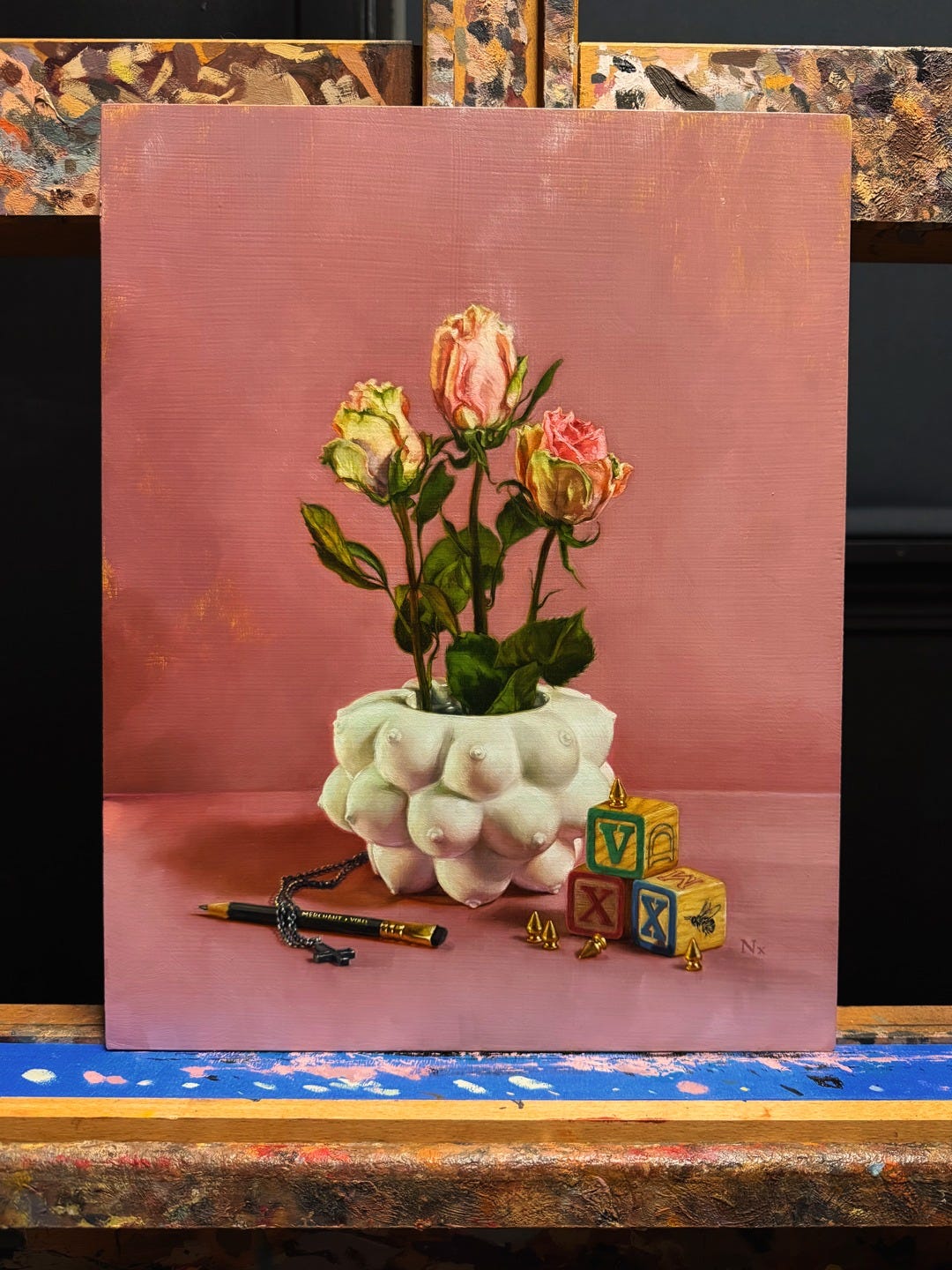
Speaking of ignorance, early on in the process of this still life, I realized that I was painting a lot of things that I had never painted before; namely, everything but the jewelry. Now it is not at all shocking that I have never had an occasion to paint a tit vase – which is a shame for many reasons; not least of which is the opportunity to paint so many boobs at so many angles in so small a space – but perhaps it is a little shocking that I had never painted a rose, dried or otherwise. With the exception of some amateur cherry blossoms in the early aughts, I had never really painted flowers of any kind until this painting. I am predominantly a figurative painter, but that is ridiculous…and kind of embarrassing.
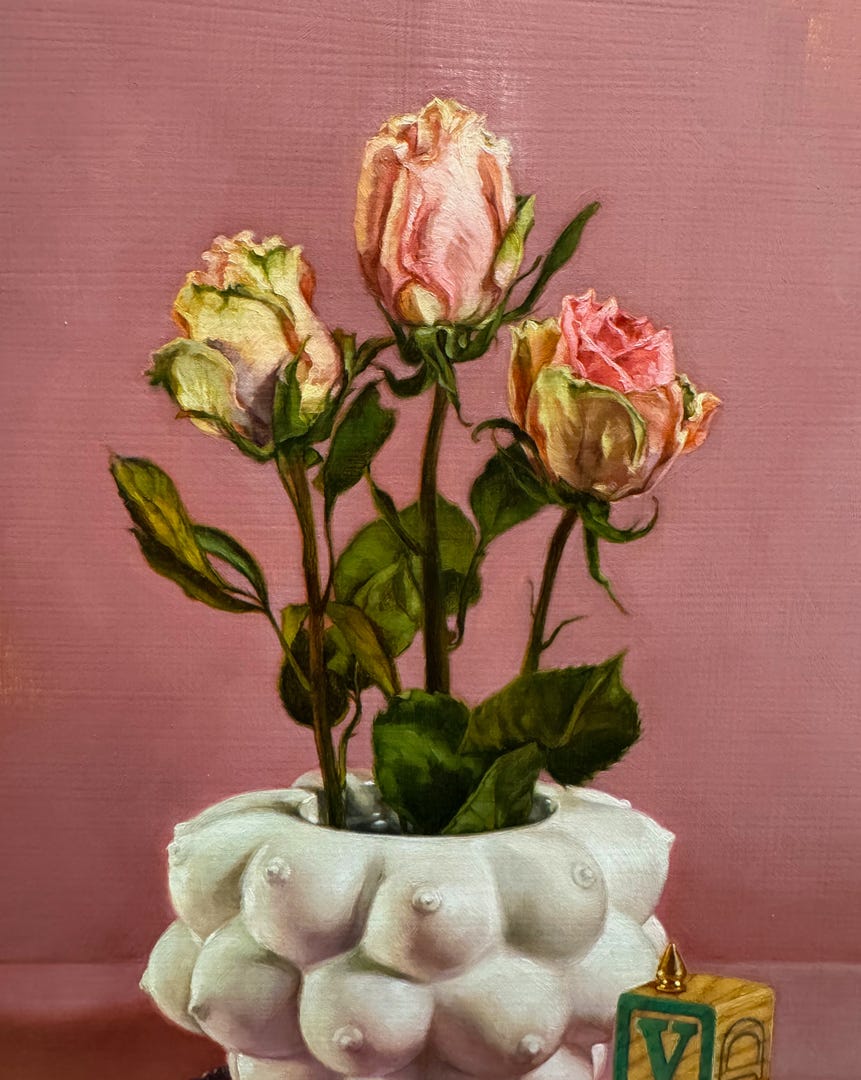
It’s not that painting one thing is necessarily unlike painting another thing. When you are a painter that predominantly paints from reference, what you happen to be painting is to some extent irrelevant, or at least incidental as compared to the process of painting it. There may be unfamiliar textures and colors that don’t often appear in a figurative painting, but really all you are trying to do for every [representative] painting, is translate the values, colors, and textures of your reference (be it observational or photographic) onto the canvas. That’s it.
So what was notable to me during this particular painting wasn’t necessarily the novelty of painting new subjects, but my inexperience with an entire genre of painting. Ultimately the differences between a still life painting and a figurative painting don’t actually feel that unfamiliar to me beyond some obvious compositional choices, but I can’t help but be aware of the hundreds of years of still life tradition lurking beyond that painting of the tit vase. Like an accomplished jazz musician trying to play metal for the first time, it feels like something completely new. Years of experience and technical proficiency will certainly help, but one has to be prepared to be a very “meh” metal musician, or still life painter, for as much time as it takes. And it is probably longer than we think.
As with all art forms, the genre, and sub-genre, and sub-sub-genre (and on and on) carry a lot of weight. A good portion of my identity comes from a combination of musical, dietary, and philosophical sub-genres. We all love placing things in their respective categories, and while it seems easy to bemoan the tendency as some sort of creative restriction, those categories offer some safety. I’m going to sit over here in my studio for 20 years and get good at figurative oil painting. I’m comfortable here. But am I also missing out a bit? Very possibly. I owe it to myself to discover why I’m not predominantly a still life painter, or an equine painter, or a landscape painter. If only to avoid feeling like a complete hack every time I dabble in another department.
So anyway, I have many excuses for the aforementioned lapse – most of which aren’t even a little bit valid – but it boils down to this: as somebody that didn’t go to art school, I was (and am) the only one responsible for making myself do things. If I didn’t feel particularly compelled to paint a flower, I didn’t paint a flower.
There is a bit of romanticism around the “self-taught” artist (a misnomer that deserves some future dissection), but there are some definite disadvantages, some more obvious than others. The lack of a formal education is not something I think about much, and the older I get, the less relevance it seems to have. But it is notable that 25+ years into painting “professionally”, I’m still finding significant gaps in my practice – gaps that I suspect might have been covered in the first few months in art school. While even the most educated can’t be exposed to everything, those of us who skipped formal training just missed a lot of the basics – the forced exposure – especially when it comes to the things we may not actually be that interested in. It’s ironic that, as an adult, we learn that initial interest is not necessarily the indicator we thought it was. Most of my favorite things from food, to movies and music, took actual work to learn to love.
So I’m going to make an effort to paint some things outside of my wheelhouse despite my somewhat fickle levels of interest and engagement – beyond the subject matter and across genres (and sub-sub-genres!) It may continually lead me back to painting the figure – and I suspect it will – but I’ll hopefully be a better artist for it.
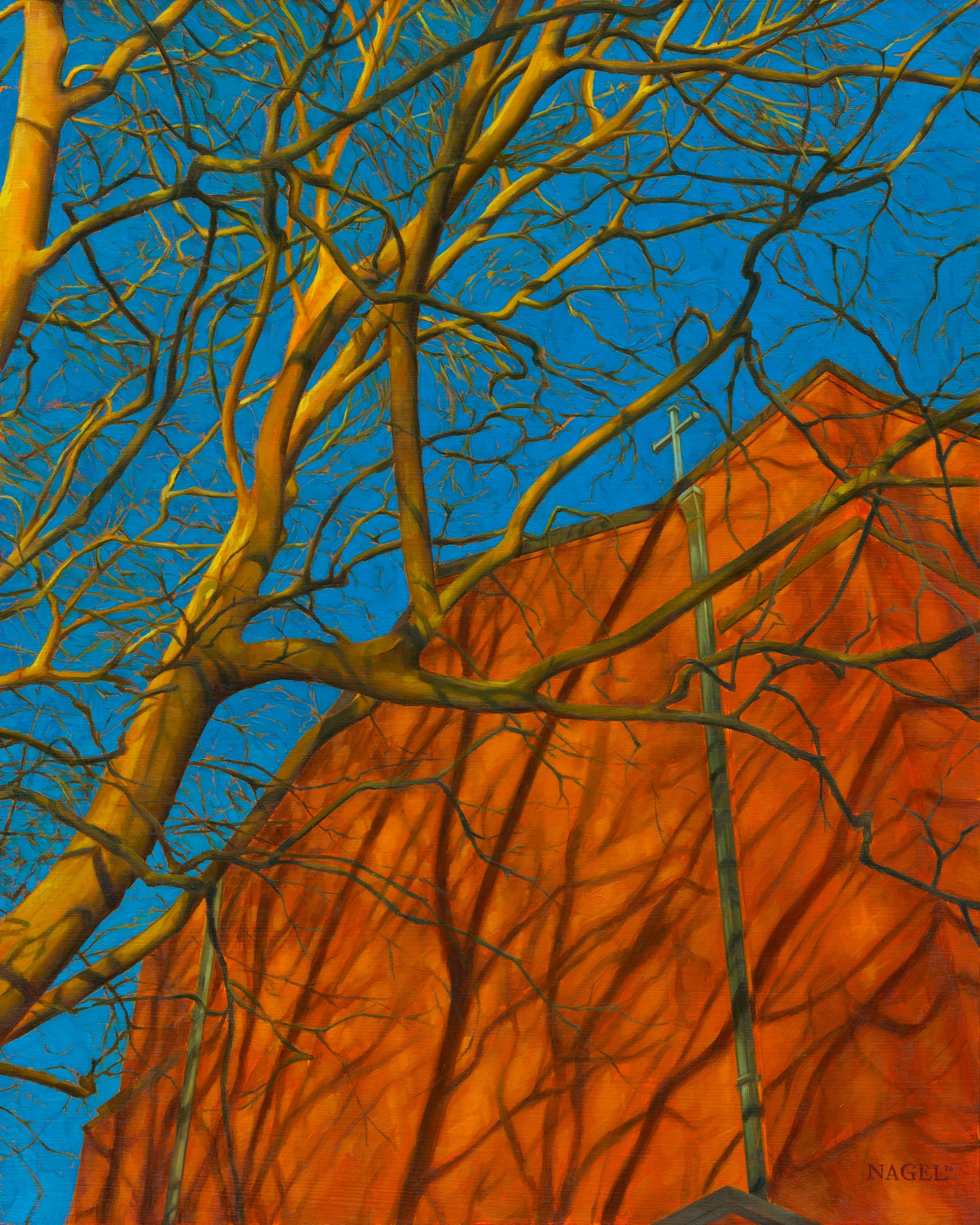
Speaking of…behold! my first real landscape. I took this reference photo several years ago at a creepy religious school a few blocks from my house and always wanted to paint it. I’m a landscape painter now.
Now who’s got a horse?


I actually know nothing about your paintings and am unsure how I’ve stumbled across your Substack, but this piece of writing was so refreshing: an artist grappling with a new subject, not claiming to have all the answers. Lately the entire internet feels as though it’s trying to “teach” me something (I.e. sell me something by telling me what I lack), so this piece was fresh air. Thanks for that. Love your writing.
The lighting and shadow of those branches engulf me!